How to prepare a technical and financial proposal for Saudi tenders: a step-by-step guide
The technical and financial proposal is the document that separates the bidder who wins from the one who is disqualified. In Saudi tenders, public and private alike, every bidder submits a technical proposal proving it can deliver and a financial proposal stating its price, and both are evaluated in a fixed order under fixed rules on the Etimad platform. This guide covers the concept, the components, the preparation steps, the evaluation, the common mistakes and the statutory figures that apply, and ends with the questions bidders ask most.
Start your proposalWhat does this service cover?
A technical and financial proposal is two separate documents submitted together in response to a tender document. The technical proposal answers the question "how will you deliver?" and is scored; the financial proposal answers "at what price?" and is usually opened only after the technical threshold is met. On Etimad, the Ministry of Finance platform, each is uploaded to its own electronic envelope, and any price inside the technical envelope is direct grounds for disqualification. The whole process is governed by the Government Tenders and Procurement Law and its implementing regulations.
What is a technical proposal?
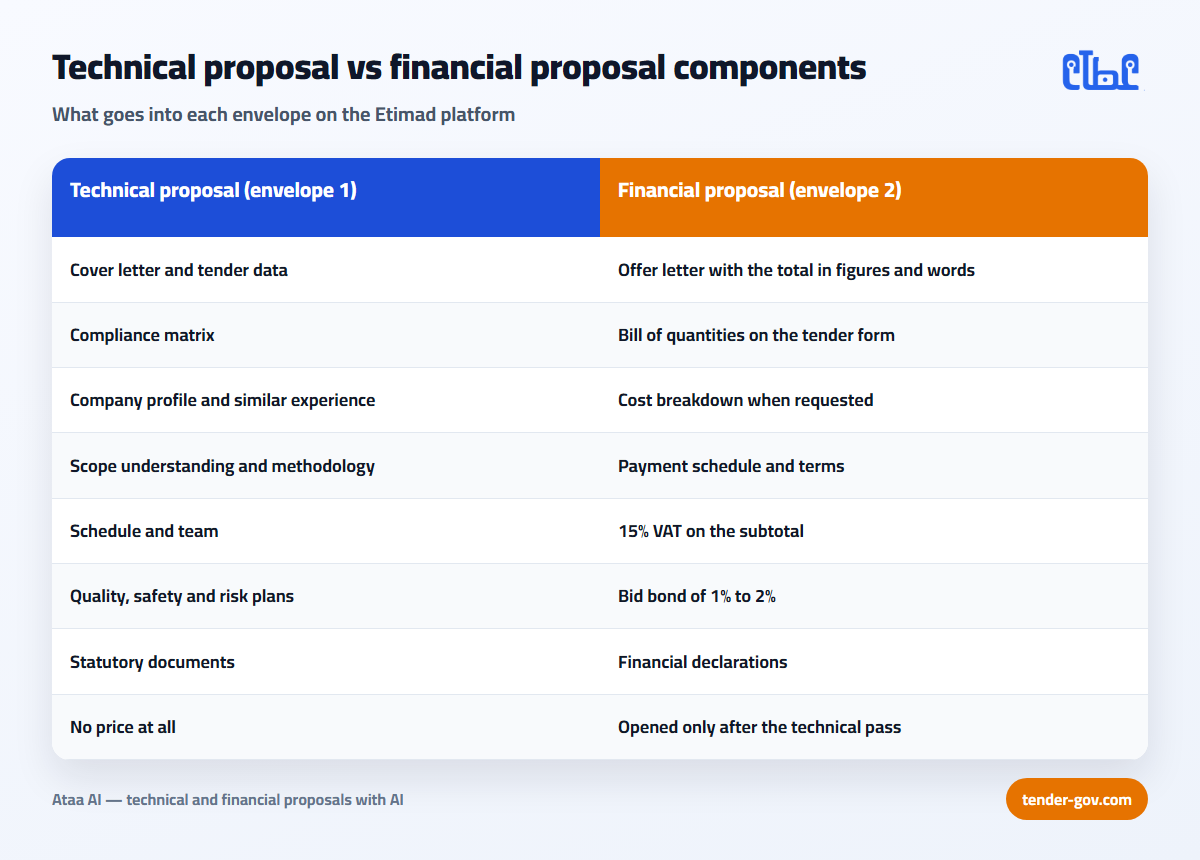
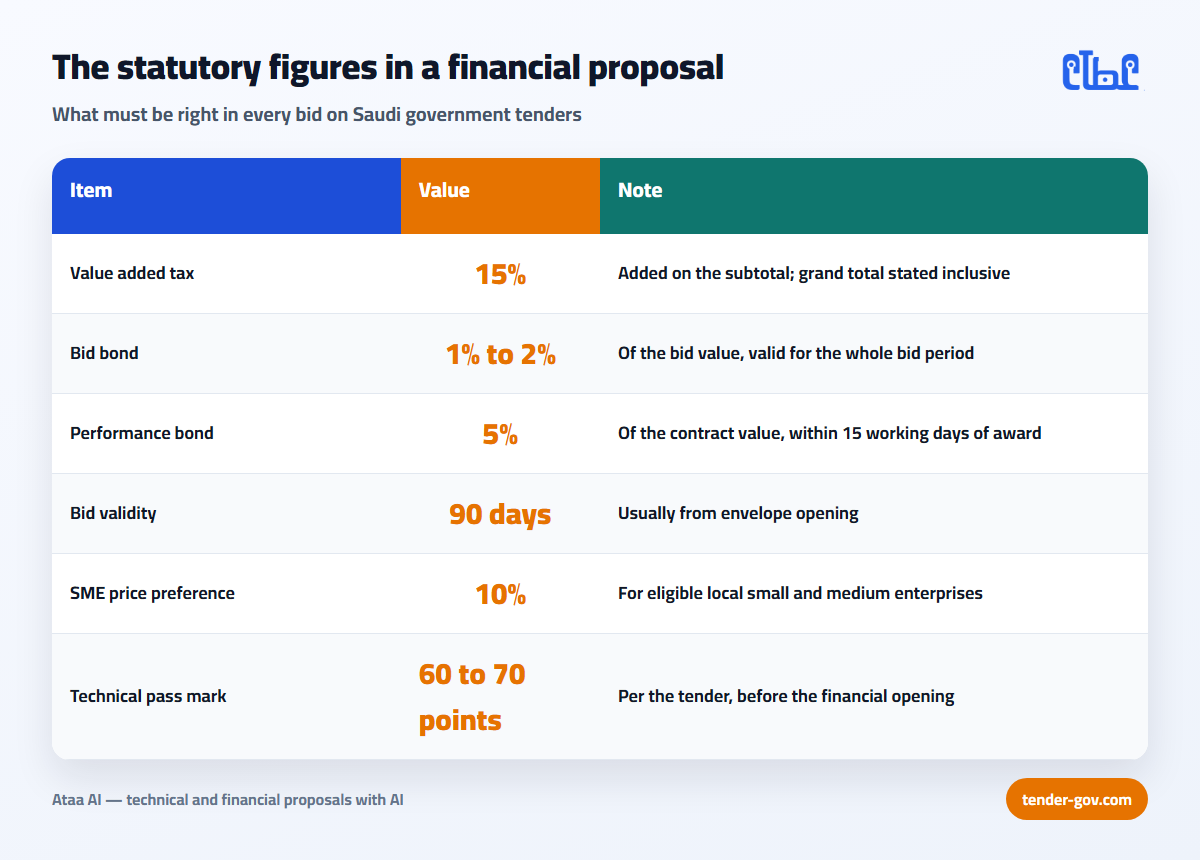
The technical proposal explains your understanding of the scope, your delivery methodology, your team and equipment, your schedule, and your quality, safety and risk plans, supported by past experience and statutory documents. It contains no price. The evaluation committee reads it against the published criteria and their weights, scores it out of one hundred, and it must exceed the stated pass mark, usually between sixty and seventy, before your financial proposal is opened.
The difference between a winning technical proposal and a rejected one is rarely length. The committee compares the proposal with the tender clause by clause, so a proposal that follows the order of the evaluation criteria and answers every requirement where the evaluator expects it scores higher than a long proposal that is scattered or recycled from a previous bid.
What is a financial proposal?
The financial proposal is the price document: the bill of quantities priced on the tender form, an offer letter with the total in figures and words including value added tax, and payment terms when requested. It is opened after the technical evaluation, and the award usually goes to the lowest technically compliant bid, or to the highest weighted score when the tender specifies a combined evaluation.
The financial proposal is binding for the bid validity period, normally ninety days from envelope opening, and the price cannot be changed after closing or during clarifications. That is why it is built from real cost rather than from guesses about competitors.
Why the technical and financial proposal matters in government tenders
In public procurement there is no sales meeting and no presentation; the written proposal is the only chance to convince a committee that has never met you. Its importance shows in four ways:
- Formal disqualification comes before evaluation: most losing bids lose on a missing document, a wrong bond or a price in the wrong place, not on quality.
- The technical score decides who enters the price competition at all; a weak technical proposal means your competitive price is never read.
- The financial proposal becomes the contract: every unit rate in it governs payment when quantities change during delivery.
- Disciplined proposals build a record: entities return to companies that bid properly when they run limited tenders later.
Technical proposal components
Details vary with the tender, but committees expect the following sections in roughly this order:
- Cover letter: tender name, number and entity, company name, commercial registration and contacts, and a declaration of compliance with the tender conditions.
- Compliance matrix: a table linking every tender requirement to where the proposal answers it, placed at the front to ease evaluation.
- Company profile and past experience: similar projects with values, clients and years, completion certificates, and contractor classification where required.
- Scope understanding: the requirement restated in the buyer language, with deliverables, boundaries and assumptions.
- Delivery methodology: phases, activities, tools and acceptance criteria per phase, plus how changes are handled.
- Schedule and workforce: milestone timeline, project organisation chart, CVs and allocation rates.
- Quality, safety and risk plans: a risk matrix with likelihood, impact and response, a quality assurance plan, and an HSE plan for site work.
- Statutory documents: commercial registration, zakat and tax certificate, GOSI certificate, chamber of commerce membership, Saudisation certificate and professional licences.
Financial proposal components
The financial proposal is shorter but far less forgiving. Its components:
- Financial offer letter: total in figures and words including VAT, bid validity period, signature and stamp of the authorised person.
- Bill of quantities: every item with a unit rate and total, no change to items, units or quantities, and no empty line.
- Cost breakdown when requested: materials, labour, equipment, indirect costs and margin, proving the price is realistic.
- Payment schedule and terms: aligned with the tender mechanism, whether monthly certificates or milestone payments.
- Bid bond: a bank guarantee at the percentage the tender sets, between 1% and 2% of the bid value, sometimes required with the technical envelope depending on the tender.
- Financial declarations: no obligations preventing contracting, and eligibility for price preference where it applies.
How to prepare the technical and financial proposal step by step
This is the order professional bid teams work in; AI tools can shorten the time without skipping any stage:
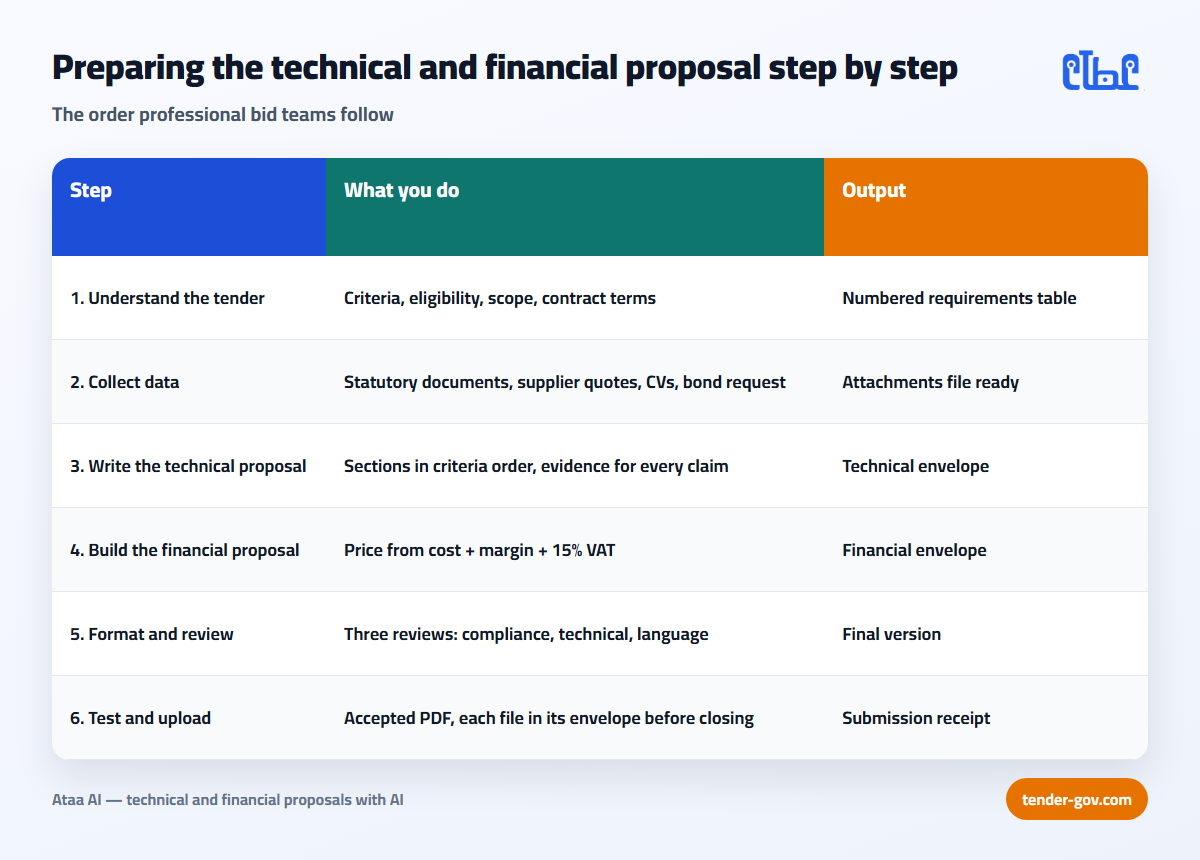
1. Understand the tender document
Start with the evaluation criteria, their weights and the technical pass mark, then eligibility conditions and mandatory documents, then scope and specifications, then contract terms such as penalties, bonds and payments. Extract every sentence containing "must" or "mandatory" into a numbered requirements table; that table is the basis of both the compliance matrix and the proposal structure.
2. Collect data and documents
Gather the statutory documents and confirm they remain valid beyond the envelope opening date, obtain real quotes from suppliers and subcontractors, and prepare CVs and completion certificates. Request the guarantee letter from the bank days before closing; a late bond is the most common reason fully prepared bids are lost.
3. Write the technical proposal
Write the sections in the order of the evaluation criteria and tailor every paragraph to this tender: the entity name, the sites, the quantities and the vocabulary of the document. Generic paragraphs that could be pasted into any bid are spotted immediately and lower the score. Attach evidence with every claim: a completion certificate with every similar project and a CV with every team member.
4. Build the financial proposal
Price the BOQ lines from direct cost, add indirect costs, a risk margin and profit, then add 15% VAT on the subtotal. Check the unit of every line before its rate, compute totals with formulas rather than by hand, and make sure the total in the BOQ matches the total in the offer letter in figures and words.
5. Format and review
Unify the branding, numbering and table of contents, add the compliance matrix at the front, then run three independent reviews: compliance clause by clause against the tender, a technical review of figures and tables, and a language review. The most critical check is that the technical file contains no price or financial hint.
6. Final test and upload
Export the files in the PDF format the platform accepts, confirm they open, their size and page order, then upload each file to its envelope on Etimad well before closing so the upload completes. Keep the submission receipt and a full copy of what was uploaded.
Submission and evaluation on the Etimad platform
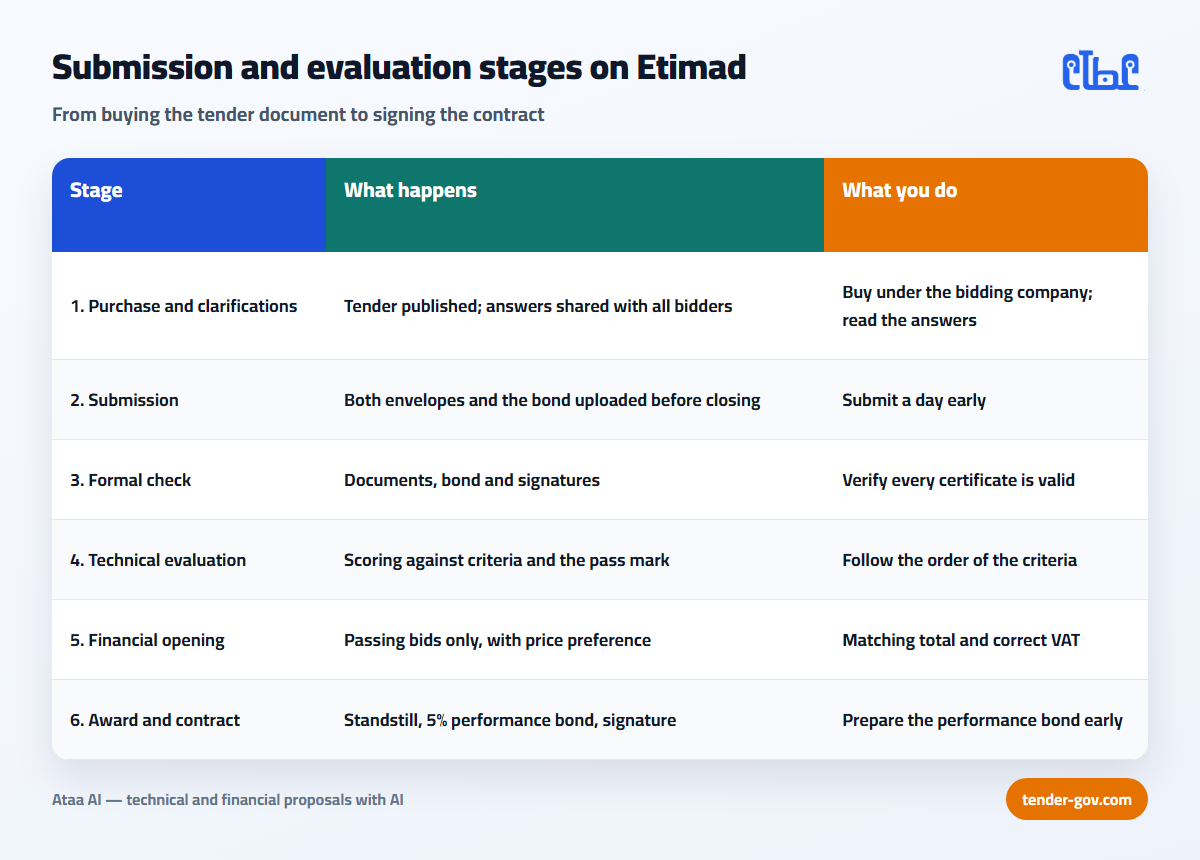
Etimad is the only gateway for Saudi government tenders. You buy the tender document from the tender page under the same company that will bid, follow clarifications and the answers published to all bidders, then upload the technical and financial envelopes with the bid bond before closing.
After closing, the process follows fixed stages:
- Technical envelope opening and a formal completeness check of documents, bond and signatures; incomplete bids are excluded before any reading.
- Technical scoring against the tender criteria, with each bidder seeing a pass or exclusion result in its account.
- Financial envelope opening for passing bids only and ranking, applying price preference rules for SMEs and local content.
- Award announcement, then a standstill period for appeals before contract signature.
- The winner submits a performance bond of 5% of the contract value within the statutory period, then signs the contract.
VAT and bonds in the financial proposal
These figures must be right in every bid; any error is caught at the formal check:
- Value added tax at 15% under the rules of the Zakat, Tax and Customs Authority, added on the subtotal with the grand total stated inclusive, plus a valid VAT registration certificate.
- A zakat and tax certificate valid on the envelope opening date; it is a non-negotiable eligibility condition.
- A bid bond between 1% and 2% of the bid value as the tender sets, valid for the whole bid period, addressed to the official entity name on the tender template.
- A performance bond of 5% of the contract value submitted by the winner within fifteen working days of the award notification.
- Price preference: a 10% preference for local small and medium enterprises, and national product preference under local content rules.
Common mistakes that disqualify bids
From evaluation committee records, these mistakes recur more than any others, and a ten-minute review avoids all of them:
- A price or financial hint inside the technical envelope.
- A bid bond below the required percentage, shorter than the bid validity, or addressed to an inaccurate entity name.
- A zakat or GOSI certificate expired on the opening date.
- Edited BOQ items, an unpriced line, or a multiplication error between quantity and unit rate.
- Missing VAT, or a total that differs between the BOQ and the offer letter.
- A technical proposal recycled from another tender, carrying another entity name or figures that do not belong to this document.
- Submitting in the last hour with large files that do not finish uploading.
- Mandatory tender forms left unsigned or unstamped.
Tips for a winning technical and financial proposal
What sets winning proposals apart is discipline and tailoring, not size:
- Start with the compliance matrix and build the proposal around it; it is the map the evaluator uses.
- Back every claim with attached evidence: a certificate, a CV, a previous contract or a licence.
- Price from real cost with a clear risk margin; never chase the lowest price into a loss.
- Use the clarification window; one answer can change the whole pricing.
- Register your company size with the SME authority and highlight your local content share to benefit from price preference.
- Submit a full day before closing and keep a standard checklist applied to every tender.
- Reuse a structured template, but rewrite the content for every tender document.
How long does it take, and how AI shortens it
Manually, a technical and financial proposal for a mid-sized tender takes three days to two weeks, most of it reading the document, extracting requirements and writing recurring sections. On Ataa AI you upload the tender PDF; the AI extracts requirements, scope, evaluation criteria and the BOQ, then drafts a technical proposal with its core sections and a financial proposal with a matching BOQ, cost breakdown and computed VAT, inserting your company profile and experience automatically.
Human review, statutory documents and the bond remain your responsibility, but the time moves from writing to checking, which raises quality and cuts disqualification errors. Files export to PDF, Word and Excel for upload to each envelope on Etimad.
Technical and financial proposal templates and samples (PDF, Word)
Complete samples shown page by page so you know the final shape before you start, a templates page with free PDF downloads and an editable Word and Excel version, plus two articles on passing the evaluation committee:
- Free PDF proposal samples and Word templates
- Engineering and design services sample
- General supply sample
- Information technology sample
- Catering services sample
- Roads operations and maintenance sample
- Maintenance and operations sample
- Article: ready proposal template guide
- Article: passing the evaluation committee
Conclusion
A technical and financial proposal is not a form to fill but a response designed for one specific tender: a technical proposal that follows the evaluation criteria and proves every claim with evidence, a financial proposal built from real cost with a matching BOQ, correct VAT and sound bonds, and a disciplined upload to Etimad with each file in its envelope. Bidders who keep to this order clear the formal disqualification that removes half the field and enter the real competition on quality and price.
What you get
- ✓ Technical proposal ordered like the tender and its criteria
- ✓ Financial proposal with matching BOQ, cost breakdown and payment schedule
- ✓ Compliance matrix linking every requirement to its answer
- ✓ Company profile and experience inserted automatically
- ✓ Editable PDF, Word and Excel exports
- ✓ A complete draft in minutes instead of days
How it works
- 1. Analyse the tender
Upload the PDF and extract requirements, criteria and BOQ.
- 2. Generate the draft
Create the technical and financial proposals from the extracted data and your profile.
- 3. Review and export
Check figures and attachments, export both files and upload each to its envelope.
Pre-submission checklist
- □ No price or financial hint inside the technical file
- □ Bid bond at the required percentage and validity, addressed to the right entity
- □ Commercial registration, zakat, GOSI and chamber certificates valid and attached
- □ BOQ identical to the tender in items, units and quantities
- □ 15% VAT added; grand total in figures and words
- □ Signed, stamped, and in the PDF format Etimad accepts
Frequently asked questions
What is the difference between the technical and financial proposal?
The technical proposal explains how you will deliver and is scored against the tender criteria; the financial proposal states the price and is usually opened after the technical evaluation. Each is submitted in its own envelope on Etimad.
Can the technical and financial proposals be submitted in one file?
No. Etimad has an envelope for each, and any price inside the technical envelope risks disqualification because the committee scores the technical proposal before opening the financial one.
What are the most important documents in the technical proposal?
The cover letter, the compliance matrix, the company profile with similar experience and its certificates, scope understanding and methodology, the schedule and team with CVs, quality and risk plans, and the statutory documents: commercial registration, zakat, GOSI, chamber, Saudisation and licences.
How are proposals evaluated on the Etimad platform?
A formal check of documents and bond first, then technical scoring against the tender criteria and pass mark, then financial opening for passing bids with price preference applied, then the award announcement and a standstill period for appeals.
What taxes should the financial proposal consider?
Value added tax at 15% under the Zakat, Tax and Customs Authority rules, added on the subtotal with the total stated inclusive, plus valid VAT registration and zakat certificates. Other taxes depend on the activity and are stated in the tender.
What happens if the technical proposal fails the evaluation?
Your financial proposal is never opened and the bid bond is returned after the award. The exclusion appears in your Etimad account, and you may appeal during the standstill period if you believe the evaluation was wrong.
What are the common mistakes in proposal preparation?
A price in the technical envelope, a deficient or expired bond, expired certificates, an unpriced or miscalculated BOQ line, missing VAT, a proposal recycled from another tender, and last-minute submission.
How long does it take to prepare a technical and financial proposal?
Manually three days to two weeks depending on the tender size. With Ataa AI you get a complete draft in minutes, leaving time for human review, documents and the bond.
Can I use a ready technical and financial proposal template?
Yes, as a starting point for structure and wording, but the content must be tailored to each tender: scope, criteria and BOQ differ every time, and an untailored template is spotted immediately and lowers the score.
Is the tender always awarded to the lowest price?
In most tenders yes, among technically compliant bids, with price preference for SMEs and national products. Some tenders use a weighted evaluation combining the technical score and the price, and say so explicitly.